#DiscoverTheDifference: From a cost centre to a profit driver: how modern intralogistics is redefining the warehouse
The warehouse – often underestimated, but full of potential
When companies talk about productivity, digitalisation and competitiveness, the focus is usually on production and sales. The warehouse, on the other hand, is often still viewed as a necessary cost factor – an area that requires space, ties up staff and incurs costs.
Yet this is precisely where one of the greatest potentials for many companies lies.
In many businesses, wasting time and space is still the rule rather than the exception. Employees spend valuable working time searching, walking, waiting or dealing with inefficient processes. At the same time, warehouse space has grown organically over the years and is becoming increasingly scarce, expensive and difficult to manage.
The good news is that, with the right technologies, the warehouse can evolve from a cost centre into a genuine value-adding asset.
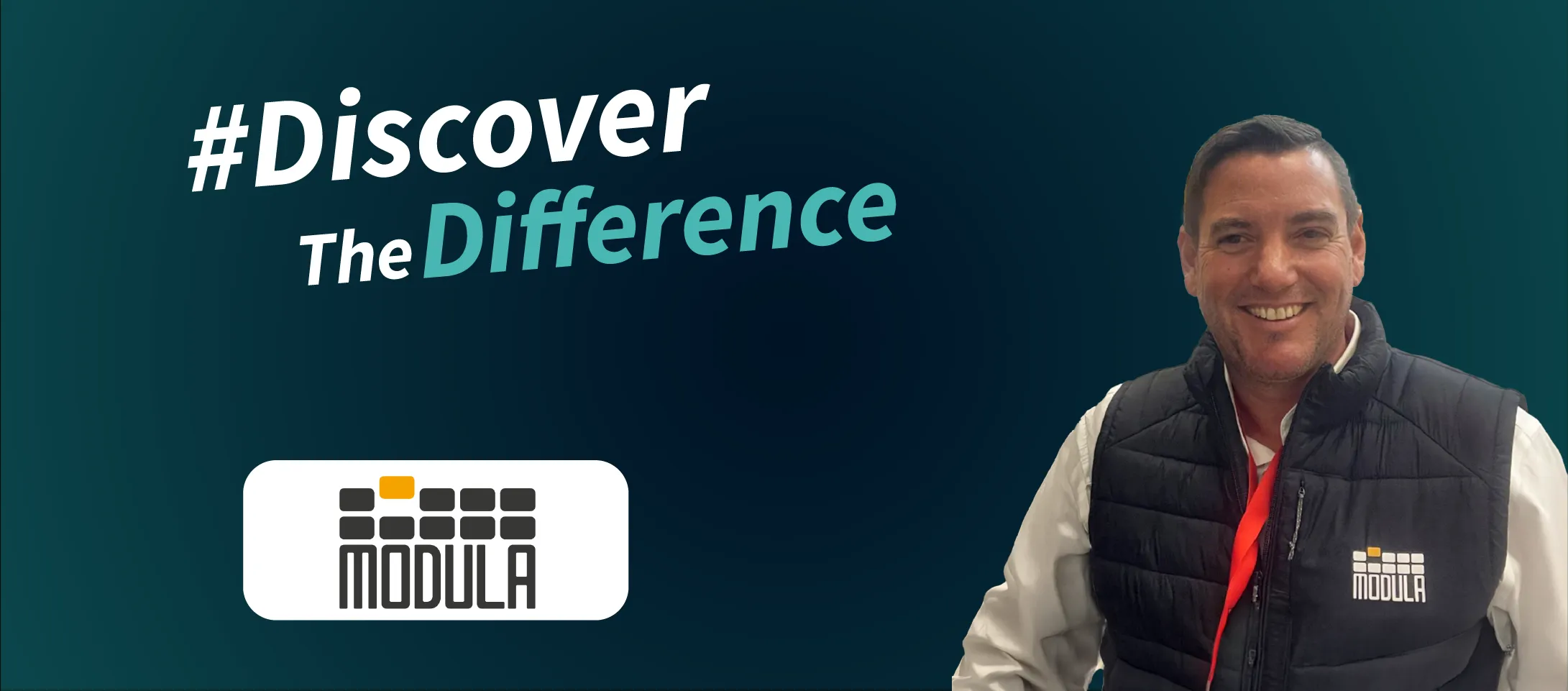 Björn Strohm, Business Development Europe Modula – driving efficient and space‑optimized intralogistics through vertical storage solutions.
The hidden costs in the warehouse
The biggest challenges are often not visible at first glance:
- Long search times for items
- Long walking distances for staff
- Insufficient warehouse visibility
- Errors in picking and stock management
- Waste of space due to static shelving systems
- High administrative workload
Each of these factors costs time. And today, more than ever, time is money.
Whilst production processes have been optimised over decades, many warehouses still operate according to principles that differ little from those of 20 years ago.
Space is the new currency
Rising property prices and limited expansion options are forcing companies to use existing space more intelligently.
This is where Modula’s vertical storage technology comes in.
Instead of expanding outwards, a Modula Lift utilises the height of the building. Thanks to the ‘goods-to-person’ principle, items are automatically brought to the operator. This allows for:
- save up to 90% of the required storage space
- walking distances to be virtually eliminated
- significantly reduce access times
- create ergonomic workstations
The effect is immediately measurable: greater storage capacity in a smaller space, combined with higher productivity.
Digitalisation creates transparency
But modern intralogistics doesn’t stop at the storage lift.
A key success factor is intelligent software control. With Modula’s solutions, a digitalised warehouse is created that offers transparency regarding stock levels, movements and processes at all times.
Modula WMS
With the Warehouse Management System:
- Warehouse movements are tracked in real time
- Inventory is managed transparently
- Picking processes are optimised
- Error rates are reduced
- ERP systems are integrated
Gut feeling becomes data transparency.
Automation where it delivers real benefits
Many companies associate automation exclusively with major investments or complex robotics projects.
In fact, automation starts with intelligent assistance systems:
- Pick-to-Light
- Put-to-Light
- LED/laser pointer systems
- Barcode and scanner solutions
- Variable storage strategies
- Integration of autonomous guided vehicles (AGV/AMR)
The aim here is not to replace people, but to increase their productivity and reduce monotonous tasks.
Sustainability through efficiency
A more efficient warehouse means more than just lower costs.
Less floor space, lower energy consumption, fewer errors and shorter transport routes also make a significant contribution to sustainability.
Companies benefit in two ways:
- lower operating costs
- a better environmental footprint
A combination that is increasingly expected by customers and investors alike.
The warehouse as a strategic success factor
The question today is no longer whether companies should modernise their intralogistics.
The crucial question is:
How much potential currently remains untapped?
Those who consistently analyse warehouse processes and utilise modern technologies will gain:
- greater productivity
- greater delivery capability
- better stock quality
- more satisfied employees
- lower costs
- greater competitiveness
Conclusion
At a time when skilled workers are in short supply, space is expensive and delivery times are crucial, no company can afford to view its warehouse merely as a cost centre.
Modern intralogistics solutions from Modula demonstrate how a traditional warehouse can be transformed into an intelligent value-added area. By combining vertical warehouse technology, software, digitalisation and automation, a warehouse is created that no longer incurs costs but actively contributes to the company’s bottom line.
The warehouse of the future isn’t bigger. It’s smarter. And that is precisely where its strength lies. Think Vertical! Think Modula!