#DiscoverTheDifference: Why Warehouses Still Waste Space
In intralogistics, there is often an unspoken rule: higher performance requires more space.
Wider aisles, more equipment, more components - and ultimately a warehouse that is larger, more expensive, and more complex than originally planned.
But what if this assumption is fundamentally wrong?
 Michael Rieser, Head of Sales & Marketing at ROCKETSOLUTION GmbH – designs sustainable and efficient warehouse processes
6-deep storage: efficiency comes not from more, but from less
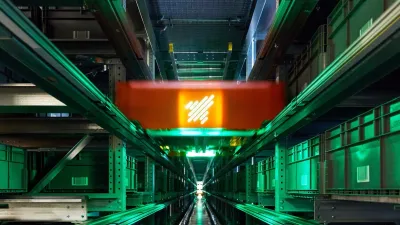
With its 6-deep storage strategy, the ROCKET shuttle system by ROCKETSOLUTION deliberately breaks with conventional system architectures. Instead of “buying” performance through additional technology, the system focuses on maximum density with minimal structural complexity - without compromising performance, availability, or future scalability.
The result: one of the most compact bin and tray storage systems on the market.
This is made possible by transverse storage, extremely small clearances, and particularly narrow aisles. While longitudinal storage systems with double- or triple-deep configurations typically require around five meters of system width, the ROCKET system operates with just 4.1 meters at 4-deep and 5.7 meters at 6-deep, while achieving a significantly higher storage density.
Depending on the system design, this enables up to 30% space savings - or alternatively up to 30% additional storage locations - without any investment in additional building space.
Deeper storage without shifting performance limits
The system is designed for either 4-deep storage up to 50 kg or 6-deep storage up to 35 kg per bin or tray.
System heights of up to 26 meters and aisle lengths of over 100 meters are just as feasible as the use of standard container formats such as 600 × 400 mm or 650 × 450 mm.
What is critical is not only the depth, but the underlying system logic:
Each shuttle serves eight or twelve Z-positions per level, regardless of storage depth - ensuring high access speeds without any level or aisle changes.
Reliability starts with architecture
While many shuttle systems are becoming increasingly complex, ROCKETSOLUTION follows the opposite approach: consistent simplification as a principle of stability.
The ROCKET system completely eliminates batteries. Power is supplied via 230 V conductor rails, eliminating charging cycles, battery replacements, and performance losses in long aisles.
At the same time, conveyor technology inside the rack is deliberately avoided. Transfers between lifts and shuttles are carried out mechanically via support angles - without additional sensors, software, or transfer mechanisms.
Multiple bidirectional lifts per aisle allow precise balancing of lift and shuttle performance while ensuring a high level of redundancy. Even under high loads, the system remains stable and highly available.
Stability - even where other systems reach their limits
A common issue in high-density storage systems is the phenomenon known as “dancing totes” - tilting or shifting containers. This effect does not occur in the ROCKET system.
The bolted steel structure, minimal spacing between containers, and telescopic load handling ensure high stability - even in long aisles with multiple lifts and multi-layer operation.
Control is handled via a standardized Siemens PLC rather than proprietary electronic solutions. Integrated cameras on shuttles and lifts enable remote diagnostics, fast fault assessment, and rapid system recovery in case of disruptions.
No roaming components, no unnecessary risks
While other systems rely on roaming shuttles or lifts, ROCKETSOLUTION deliberately avoids level and aisle changes.
This reduces single points of failure, lowers the risk of disruptions, and increases overall system availability - while maintaining consistently high performance.
Cost efficiency across the entire lifecycle
The system’s high compactness allows entire aisles to be eliminated, reducing building and investment costs.
At the same time, fewer components, lower maintenance requirements, and the absence of licensing models reduce ongoing operating costs. Standardized interfaces facilitate integration into existing warehouse management systems and shorten project and implementation timelines - resulting in a faster return on investment.
At a glance
With the EffiX Configurator from ROCKETSOLUTION, prospective customers can generate an initial system concept - including layout proposal and budget framework - in just a few steps.
More information.